XM Global Partner Code CLAIM50 to Claim $100 Welcome Bonus & Loyalty Cashback Program Create XM Account

Pivot Point Trading: What It Is, How It Works, and How to Use It
Pivot point trading is one of the most widely used methods in technical analysis. Whether you trade forex, stocks, or commodities, pivot points give you a clear objective framework for finding key levels.
Monarchforex
6/1/20264 min read
Pivot Point Trading: What It Is, How It Works, and How to Use It
By Monarch Forex Team | monarchforex.io | Updated: June 2025
Pivot point trading is one of the most widely used methods in technical analysis. Whether you trade forex, stocks, or commodities, pivot points give you a clear, objective framework for identifying key price levels — without relying on guesswork. In this guide, Monarch Forex breaks down everything you need to know to start using pivot points effectively.
What Is a Pivot Point in Trading?
A pivot point is a technical indicator calculated from the previous session's high, low, and closing price. It acts as a key reference level that traders use to determine market direction and identify potential support and resistance zones for the current session.
Pivot points are popular because they are objective — every trader using the same data gets the same levels. This creates self-fulfilling zones where large numbers of traders watch and react to price, making them especially reliable in liquid markets like forex.
The core pivot point (PP) is calculated using this formula:
Pivot Point (PP) = (Previous High + Previous Low + Previous Close) ÷ 3
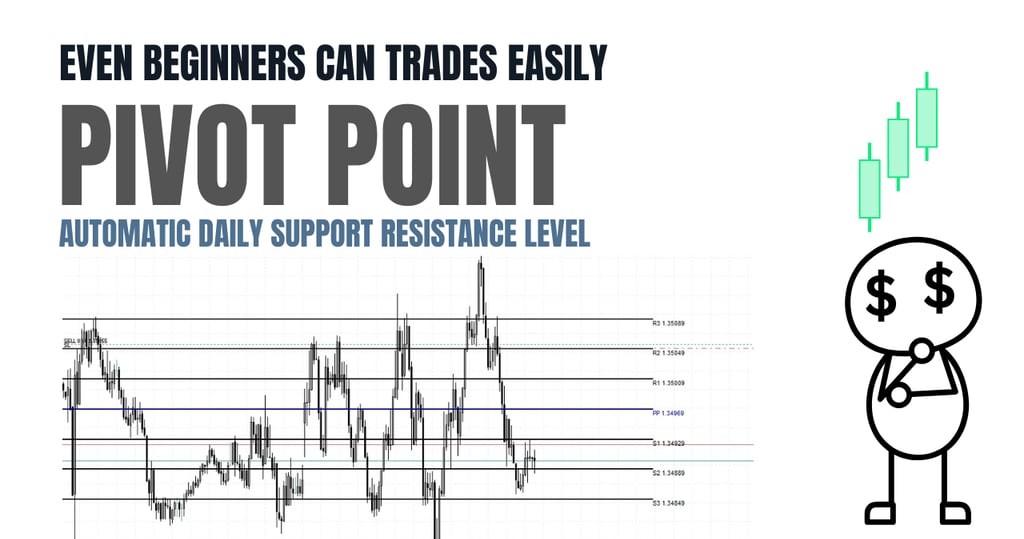
From the PP, additional support (S1, S2, S3) and resistance (R1, R2, R3) levels are derived, giving you a full map of key zones for the trading day.
Understanding Pivot Point Levels
Here is a quick breakdown of what each level means and how traders use them:
R2 & R3: Strong resistance zone, Shorting opportunities, reversal signals
R1: First resistance above PP, Price may stall or reverse here
PP (Pivot Point): Key equilibrium level, Direction bias for the day
S1: First support below PP, Price may bounce or break
S2 & S3: Strong support zones, Buying opportunities, bounce signals
If price opens above the pivot point, the market is considered bullish for the session. If it opens below, the bias is bearish. Traders use this directional bias to filter their setups and avoid trading against the dominant flow.
How to Use Pivot Points in Your Trading
1. Identify the day's directional bias
The first thing to check every morning is whether price is trading above or below the pivot point. Above PP = look for buying opportunities. Below PP = look for selling opportunities. This one rule alone keeps you on the right side of the market most of the time.
2. Trade bounces at support and resistance
When price approaches S1 or R1, watch for a reaction. A strong bounce with confirmation — such as a rejection candle, bullish/bearish engulfing, or a pin bar — can signal a high-probability entry in the opposite direction.
3. Trade breakouts through key levels
If price breaks through R1 with strong momentum and volume, the next target is R2. The same logic applies downward — a clean break below S1 often leads to S2. Breakout traders use pivot levels as natural targets and stop-loss anchors.
4. Combine pivot points with other indicators
Pivot points work best when combined with other tools. Common pairings include moving averages (to confirm trend direction), RSI (to identify overbought/oversold conditions at pivot levels), and candlestick patterns (to time entries more precisely).
Types of Pivot Points
There are several variations of pivot points. The most common types used by traders are:
• Standard (Classic) Pivot Points – the original formula used by floor traders. Most widely recognized and respected.
• Camarilla Pivot Points – uses a different multiplier, producing levels that are tighter and closer to current price. Popular for intraday scalping.
• Woodie's Pivot Points – gives more weight to the closing price, making it responsive to recent market sentiment.
• Fibonacci Pivot Points – combines Fibonacci ratios with the pivot formula to produce levels that align with key Fib retracements.
For most traders — especially beginners — the Standard pivot point is the best starting point. It is the most widely watched, which means more traders reacting at the same levels, making those levels more significant.
Practical Tips for Pivot Point Trading
• Use daily pivots for intraday trading – and weekly pivots for swing trading. Match the timeframe of your pivots to your trading style.
• Don't force trades at every level – only act when price shows a clear reaction (rejection or breakout) at a pivot level.
• Always use a stop-loss – place stops just beyond the next pivot level to define your risk clearly.
• Mark levels before the session opens – pivot points are most useful when you know them in advance, not after the fact.
Frequently Asked Questions
What is pivot point trading?
Pivot point trading is a technique where traders use mathematically calculated price levels — derived from the previous session's high, low, and close — to identify potential support, resistance, and directional bias for the current trading session.
Are pivot points accurate?
Pivot points are not predictive in isolation, but they are highly reliable as reference levels because they are used by a large number of traders simultaneously. Their accuracy improves significantly when combined with price action confirmation and other technical tools.
What timeframe is best for pivot points?
Daily pivot points are most effective for intraday traders using 5-minute, 15-minute, or 1-hour charts. Weekly pivots work well for swing traders. The key is matching the pivot timeframe to your trading style and holding period.
Can beginners use pivot points?
Yes. Pivot points are one of the most beginner-friendly tools in technical analysis because they are objective, easy to calculate, and clearly defined. Many free charting platforms like TradingView automatically plot pivot levels for you.
Final Thoughts
Pivot point trading gives you a structured, repeatable way to read the market every day. Instead of reacting emotionally to price movement, you have clear levels to watch, clear rules for entries, and clear targets to aim for.
At Monarch Forex, we teach traders how to integrate pivot points into a complete trading strategy — combining them with trend analysis, risk management, and disciplined execution. Whether you are just starting out or looking to sharpen your edge, pivot points are a tool worth mastering.
Want to learn pivot point trading with live examples and daily analysis? Join the Monarch Forex community at monarchforex.io and start trading with a clear edge.
Contacts
team@monarchforex.io
t.me/monarchforexio
monarchforex
Risk Warning: Trading Leveraged Products such as Forex and Derivatives may not be suitable for all investors as they carry a high degree of risk to your capital. Please ensure that you fully understand the risks involved, taking into account your investments objectives and level of experience, before trading, and if necessary, seek independent advice
Monarch Forex Trading Community, A global hub for traders who want to learn, grow, and profit together. We provide free forex trading plans, market insights, and education designed to help traders of all levels. With exclusive cashback rewards on featured brokers and access to copy trading opportunities, Monarch empowers members to maximize their profits while minimizing risks.